BITE = Steven Hassan’s BITE Model of Authoritarian Control
Om man tittar närmare på bilden har det smugit sig in några roliga felstavningar bland de engelska termerna:
- “CONSCUIS’UNESS” istället för CONSCIOUSNESS
- “METACOGUITION” istället för METACOGNITION
- Och längst ner står det “AUTHOHARIAN” istället för AUTHORITARIAN.
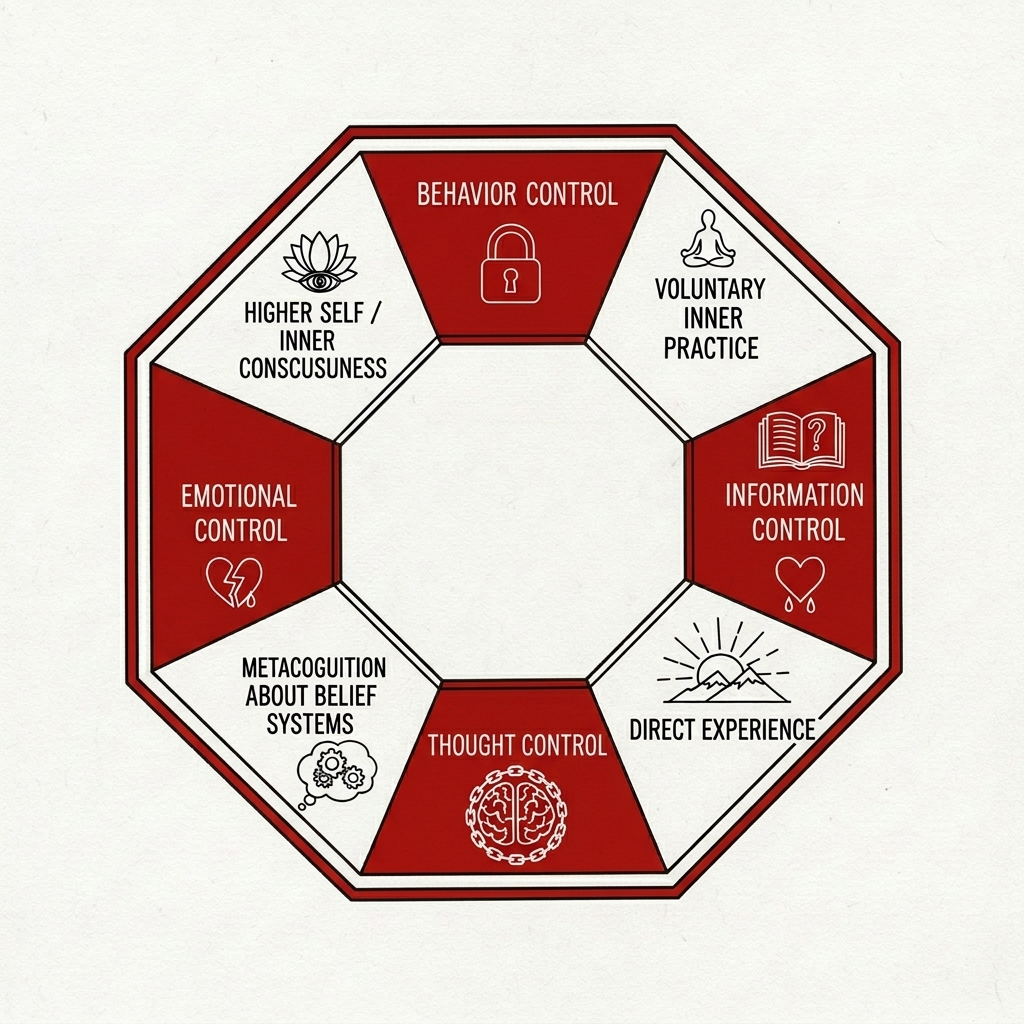
Hassan’s BITE Model of Authoritarian Control:
- B – Behavior Control (top)
- I – Information Control (right)
- T – Thought Control (bottom)
- E – Emotional Control (left)
Buhlman’s Counter-Cult Elements:
- (B) Voluntary Inner Practice
- (I) Direct Experience
- (T) Metacognition about Belief Systems
- (E) Higher Self / Inner Consciousness
Here is a compact table directly linking Buhlman’s principles to Hassan’s BITE model, in American English. I’m reusing only what we already discussed, without adding new sources.
William Buhlman as Anti‑BITE (Counter‑Cult) Framework
| BITE Area (Hassan) | Typical Cult Pattern | Buhlman‑Style Counter‑Principle | How It Helps Against Indoctrination |
|---|---|---|---|
| B – Behavior Control | Detailed rules about daily life, relationships, time use; obedience to leader determines “worthiness.” | Emphasis on voluntary inner practice (meditation, OBE exercises, journaling) where you experiment and adjust based on your experience. | Shifts focus from external obedience to internal exploration. You get used to asking “What happens when I try this?” instead of “What does the leader want?” That weakens behavior‑level control. |
| I – Information Control | Filtering of books, media, contacts; criticism framed as persecution; group narrative is the only valid lens. | “Don’t be satisfied with second‑hand beliefs – seek direct experience of consciousness and reality.” Encourages comparing teachings with lived experience and being curious about multiple perspectives. | Undermines any monopoly on information. If you are trained to ask “What is my own experience?” you are less likely to accept a group’s version of reality as the only possible one. |
| T – Thought Control | “Right” doctrines define all questions; black‑and‑white thinking (“truth vs world”); doubts pathologized. | Focus on metacognition about belief systems – noticing thoughts and beliefs as “programs” or “territories” you can observe and outgrow. | Encourages you to hold beliefs lightly and examine them. That makes it harder for a group to impose one fixed cognitive frame as absolute and unchangeable. |
| E – Emotional Control | Use of fear (hell, apocalypse, social death), guilt and euphoria tied to leader or group; love‑bombing and withdrawal. | Core idea: your deepest authority is your higher self / inner consciousness, not an external savior. Facing fear (e.g., death anxiety) as part of growth instead of being terror‑managed. | Reduces dependence on external emotional control. If your primary “judge” is an inner, compassionate awareness, threats and emotional manipulation from a leader lose much of their power. |
Put simply: Hassan shows how authoritarian groups capture behavior, information, thoughts, and emotions; Buhlman’s approach, when stripped of its esoteric packaging, trains the opposite muscles—inner authority, direct experience, critical reflection, and emotional self‑grounding. That combination is very usable as a conceptual “anti‑cult curriculum.”
American English PDF from Perplexity.AI
Can Buhlman’s ideas be used to counter sect indoctrination?

Samma på svenska
Kan Buhlmans idéer användas för att motverka sekt indoktrinering?

As a former ‘premie’ in the Guru Maharaj Ji cult (Divine Light Mission, ‘Knowledge’), the Maharishi TM cult, ‘British Israelism,’ and the Danish Martinus Cosmology cult—I’m FREE now! Thank you, William!